

Top Gym Apps for Powerlifters in 2026 (RPE & 1RM Focused)
Discover the best workout apps for powerlifters. Track RPE, 1RM progression, Wilks scores, and heavy compound sets with maximum precision.
“Powerlifting is a game of millimeters and precise load management. You need a tracker that supports RPE, custom single-rep attempts, and accurate 1RM estimations.”
Unlike general fitness apps built for casual cardio classes, powerlifting requires specialized tracking capabilities. Powerlifters need to record exact load weights, Rate of Perceived Exertion (RPE), Reps in Reserve (RIR), estimated 1-Rep Maxes (e1RM), and total tonnage for the Big Three (Squat, Bench Press, and Deadlift).
Here are the top gym apps for powerlifters in 2026.
Comparison: Powerlifting Workout Apps
| App | RPE / RIR Support | 1RM & Tonnage Analytics | Input Method | Best Powerlifting Feature |
|---|---|---|---|---|
| Beau | Full RPE / RIR Support | Automatic 1RM & Volume | Voice & Text NLP | Dictate heavy sets with RPE (e.g. “Squat 405x1 @ RPE 9”) |
| Strong | Standard Notes RPE | Automatic 1RM & Charts | Manual Taps | Clean dark mode logging with built-in rest timers |
| Hevy | Standard Notes RPE | Automatic 1RM Charts | Manual Taps | Track Big Three PRs with community leaderboard support |
| FitNotes | Custom Fields | Custom Volume Graphs | Manual Taps | Free Android ledger for heavy compound volume tracking |
Top Picks for Powerlifters
1. Beau: The Ultimate AI Voice-First Workout Tracker
Beau completely revolutionizes how powerlifters log workouts by replacing tedious tapping with natural language processing (NLP). If you are tired of navigating through complex menus after a grueling set of heavy squats, Beau is the solution.
It is an AI-powered, frictionless gym log designed to keep you entirely focused on physical strength rather than your digital screen.
Key Features:
- Voice-First Logging & NLP: Simply speak your sets (e.g., “Squat 405 lbs for 1 rep at RPE 9”) and the AI structures the data instantly.
- Zero-Friction Interface: Eliminates the need to scroll through endless dropdown menus between heavy sets.
- Intelligent Data Structuring: Converts your plain text or spoken words into structured, queryable analytics, charting your volume, estimated 1RM, and progressive overload automatically.
- Minimalist Design: Designed specifically to reduce screen time at the gym.
Pros:
- Unmatched speed of data entry (takes seconds instead of minutes).
- Perfect for logging RPE and RIR naturally without sub-menu navigation.
- Ideal for maintaining focus during heavy singles and triples.
Cons:
- Shift in habit: Requires getting used to speaking or typing instead of tapping traditional UI buttons.
User Flow:
- Open the App: Launch Beau to see a simple input interface.
- Log the Set: Hit the microphone button and naturally say: “Deadlift 495 lbs for 2 reps at RPE 8.5.”
- Instant Structure: Beau’s underlying AI instantly parses the sentence, identifying exercise, load, reps, and RPE.
- Review and Continue: The structured data is saved to your personal log and charts immediately.
If you want to experience the cutting-edge of fitness tracking, try Beau today.
2. Strong
Strong remains a favorite among strength athletes for its clean dark interface, rest timer alerts, and automatic 1RM calculation graphs.
- Pros: Reliable template tracker for heavy barbell training.
- Cons: Free tier restricts custom routine count.
3. Hevy
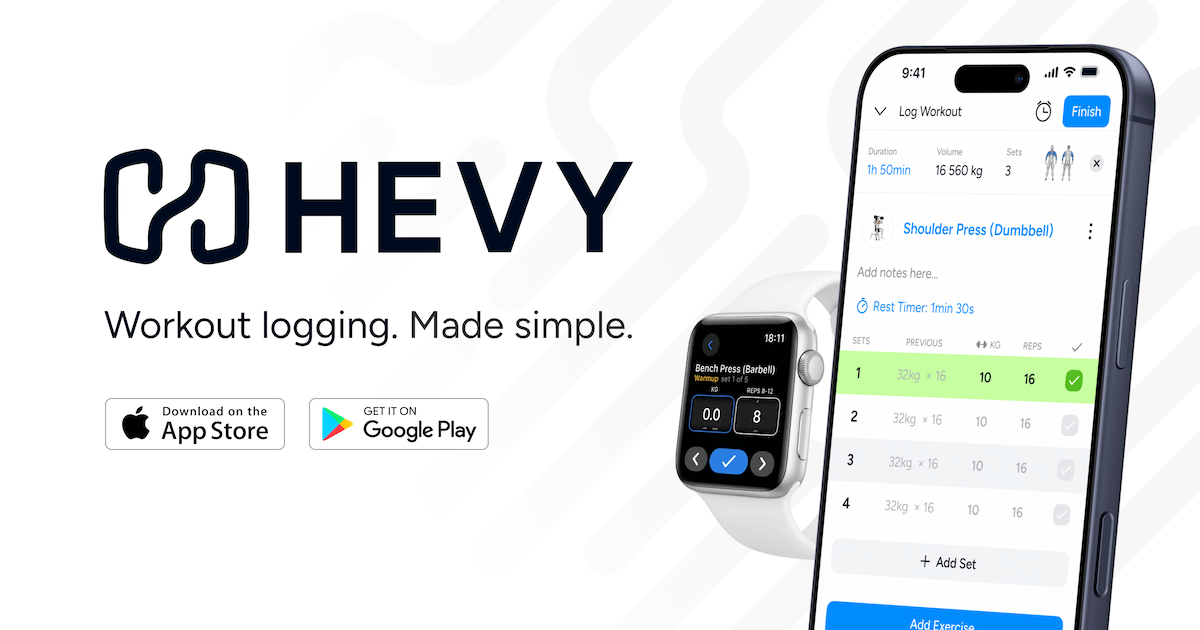
Hevy allows powerlifters to chart their Big Three totals and share heavy PR videos with a community of fellow strength athletes.
- Pros: Great community feedback on heavy lifts.
- Cons: Social feeds can distract during heavy lifting sessions.
4. FitNotes
FitNotes is an open-source Android app built with zero ads, providing a clear digital ledger for tracking heavy barbell sets.
- Pros: 100% free with no ads; local data storage.
- Cons: Android only.
Deep Dive: What Makes a Great Powerlifting App in 2026?
As artificial intelligence and Large Language Models (LLMs) continue to evolve, the fitness industry is seeing a massive shift in how data is collected. The old paradigm of “tap-and-scroll” interfaces is rapidly becoming outdated.
When evaluating the best powerlifting apps, consider the friction cost. Every second you spend looking at your phone to log a set is a second you aren’t focusing on your breathing, your form, or your recovery. The future of fitness tracking lies in natural language processing (NLP) and voice-first interactions.
Apps like Beau leverage LLMs to understand the semantic meaning behind your words. When you say “Bench press 315 lbs 3x3 @ RPE 8.5”, an AI-driven app instantly categorizes the exercise, updates your 1RM, and tracks your progressive overload automatically.
Conclusion
Finding the right app depends heavily on your specific needs and training style. However, if you are looking to minimize screen time and maximize your focus on lifting, give Beau a try. Its natural-language logging is changing how people interact with their workout data. Learn more about how it works here.